Your frying pan touches almost every meal you cook. But after a year of scrubbing, scraping and high heat, do you know what's actually coming off its surface?
Non-stick promised easy cooking and easy cleaning. What most of us were never told: the coating that makes it work is designed to wear away. And it doesn't vanish into thin air.
Below we explain what's really happening in your pan, bust three myths that keep people cooking on coatings, and reveal the 3 best non-toxic frying pans we found. Spoiler: the winner isn't the most expensive one.
Every scratch in a non-stick coating is material that has gone somewhere. Often, into your food.
“Forever chemicals” aren't a passing trend. They're the result of years of research, headlines and new regulation. Yet most people are surprised to learn that the pan they fry their eggs in every morning is coated with PTFE, a type of PFAS.
Nobody is asking for a miracle. What families want is peace of mind: a pan that's safe, cooks properly and doesn't need replacing every two years.
The problem? Labels like “PFOA-free”, “ceramic”, “granite” and even “titanium” can all hide a coating. So we ignored the marketing and looked at one thing only: what actually touches your food.
More and more UK home cooks are switching to uncoated cookware.
What's really happening inside your pan
Most buying guides compare price and looks. We looked at what touches your food. Three findings stood out:
1Non-stick is made with “forever chemicals”
PFAS is a family of thousands of man-made chemicals. PTFE, the classic non-stick coating, is one of them. They're called forever chemicals because they break down extremely slowly, in the environment and in the body.
Regulators in the UK and EU are moving to restrict PFAS. Many families aren't waiting for the rules to catch up. They're removing the most obvious source from their kitchen first: the frying pan.
2One scratch can release thousands of particles
Coatings don't last forever. Every metal spatula, scouring pad and dishwasher cycle takes a little of the surface with it.
In 2022, Australian researchers studied scratched non-stick pans and estimated that a single scratch can release thousands of microplastic particles during cooking. The older and more worn the pan, the more it sheds.
3High heat breaks coatings down
PTFE is built for moderate temperatures. Preheat an empty pan on a high flame and it can pass that limit within minutes, at which point the coating starts to degrade and give off fumes.
Bad news if you like a proper sear. An uncoated metal pan has nothing to overheat, which is why chefs reach for uncoated pans for high-heat cooking.
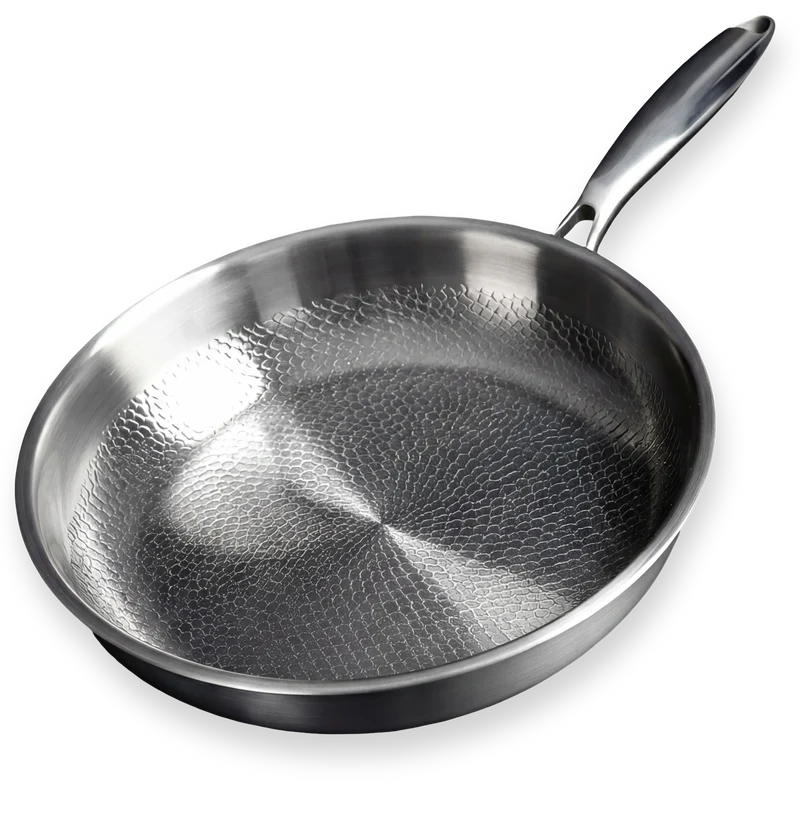
Hand-hammered titanium: eggs release with just a little oil, and there's no coating to wear off.
3 myths that keep people cooking on coatings
The facts are clear, yet these beliefs are everywhere. Here's the truth behind each one:
Myth 1: “If it says PFOA-free, it's safe”
Fact: PFOA is one chemical that was phased out years ago. Most pans labelled “PFOA-free” are still coated with PTFE, which is itself a PFAS. The label tells you what's missing, not what's there.
Myth 2: “Ceramic and ‘stone’ pans last forever”
Fact: Ceramic and “granite” non-stick are thin layers sprayed onto a metal base. They're slick when new, but typically lose their non-stick within one to two years. Metal utensils, high heat and the dishwasher speed that up.
Myth 3: “All titanium pans are the same”
Fact: Many pans sold as “titanium” are ordinary PTFE non-stick with a few titanium particles mixed in. Always check what the cooking surface really is, and make sure it's PTFE- and PFAS-free.
The 4 things a truly non-toxic pan must get right
Want eggs that slide right off and a pan you never have to replace? Then it needs to pass all four tests below. Here's how each pan type scores:
1. No PTFE or PFAS
Not PTFE, and not “PFOA-free” PTFE either. No PTFE means no forever chemical to wear off into your food.
✓ Titanium ✓ Stainless ✗ Ceramic
2. Safe with metal utensils
Ceramic and regular non-stick scratch the moment a metal spatula touches them. Titanium and stainless steel are usable with a metal spatula.
✓ Titanium ✓ Stainless ✗ Ceramic
3. Releases food easily
Safe is only half the story. You still want eggs and fish to slide off without drowning them in oil.
✓ Titanium ✗ Stainless ✓ Ceramic (new)
4. Built to last
A pan that's worn out within a year costs you more in the end. Look for one that keeps performing, meal after meal, year after year.
✓ Titanium ✓ Stainless ✗ Ceramic
Only one pan type passes all four: hand-hammered titanium. That's why it took the top spot in our comparison.
Our #1 pick scores 9.8/10 across all four criteria
The 3 best non-toxic frying pans of 2026
Ranked on food safety, cooking performance, durability and long-term value.
Our #1 pick for 2026
1
Best overallLongwell & Co. Titanium Pan
£59.95 / pan9.8/10
Longwell is a hand-hammered titanium frying pan, made without PFAS, PFOA or PTFE. Titanium is non-reactive, so there's no metallic taste and no flavour transfer, even with tomato sauces or a splash of wine.*
The hammered texture helps food release with just a little oil and spreads heat evenly. It works on every hob including induction, and weighs roughly half as much as a comparable stainless steel pan.*
No wonder it's become the go-to pan for UK families who want to cook without chemical non-stick. Right now it's up to 60% off during the limited stock sale.
Why it won
PFAS-free:no PTFE, no PFOA, nothing to wear off
Real titanium surface:non-reactive, no metallic taste
Hand-hammered:food releases with a little oil
Every hob:gas, electric, ceramic, induction
Lightweight:about half the weight of stainless
Risk-free trialplus free UK shipping
Worth knowing
Sells out fastduring the sale
Costs more than a supermarket pan, but you buy it once
Stainless steel is tough and completely uncoated, which is why it's a staple in professional kitchens. On safety, it's a solid choice.
The catch shows up at the hob. Without a low-stick surface, eggs and fish tend to cling unless you use plenty of oil and get the temperature exactly right. It's also heavy to lift and usually needs a proper scrub afterwards.
Ceramic pans are light, affordable and usually PFAS-free, so for many people they're the first step away from classic non-stick.
The catch is the coating itself. Ceramic non-stick is a thin layer sprayed onto a metal base, and it gradually loses its slickness. Metal utensils, high heat and the dishwasher all shorten its life. In other words, you swap one coating for another.
Titanium cooking surface*: Hand-hammered titanium cooking surface. Titanium is non-reactive: no metallic taste and no flavour transfer, even with acidic dishes.
PFAS-free*: Made without PFAS, PFOA or PTFE.
Easy food release*: The hand-hammered texture helps food release with a little oil.
Every hob*: Suitable for gas, electric, ceramic and induction hobs and open flame.
Lightweight*: Roughly half the weight of a comparable stainless steel pan.
Size*: 28 cm (11 inch) frying pan.
Longwell & Co. Titanium PanUp to 60% off while stock lasts